Paver Patio vs Concrete Patio in Northern Illinois: What Actually Lasts on Fox Valley Clay
V. Cardenas Landscaping builds paver patios across northern Illinois, and on Fox Valley clay a paver patio outlasts a poured concrete slab for one reason: what happens underground. Frost drives roughly 40 inches deep here and heavy clay heaves when it freezes, cracking a rigid slab while a paver field shifts and resets. After more than 20 years building and repairing patios in the Fox Valley, here is how Virgil weighs the two on a site visit.
Paver patio vs concrete patio: the real difference on Fox Valley clay
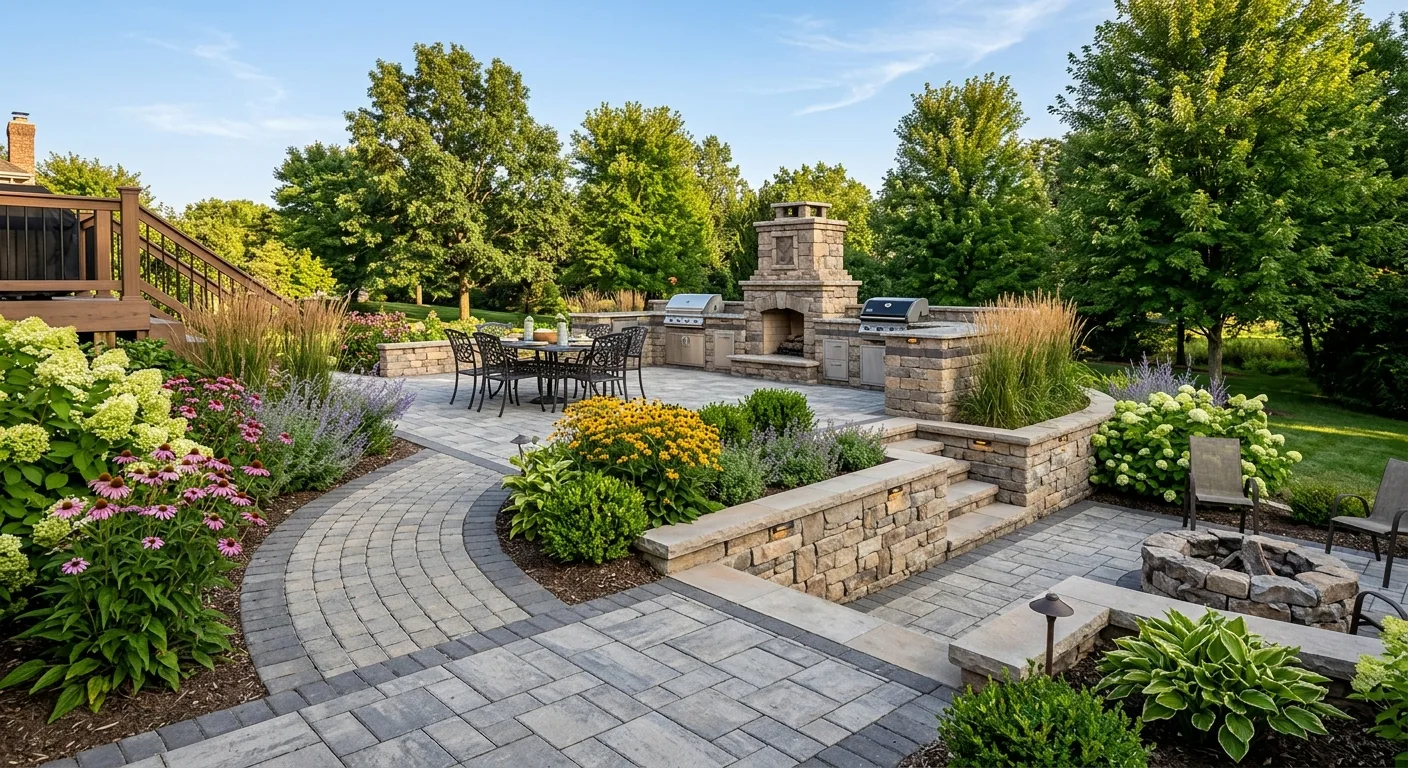
A paver patio is dozens of individual units set on a compacted stone base that flexes with the ground; a concrete patio is one rigid slab that has to hold together as the earth under it moves. That single structural difference drives almost everything else. When our clay soil swells with frost and settles again in spring, a paver surface shifts as a field of small pieces and stays intact, while a rigid slab has nowhere to give and relieves the stress the only way it can, by cracking. On the flat clay lots common across the Dundee area, that's not a maybe. It's the default outcome for a slab that wasn't built with serious base prep.
People assume the choice is mostly cosmetic. It isn't. The look is real, but the reason we steer most Fox Valley homeowners toward pavers is what happens underground, not on top.
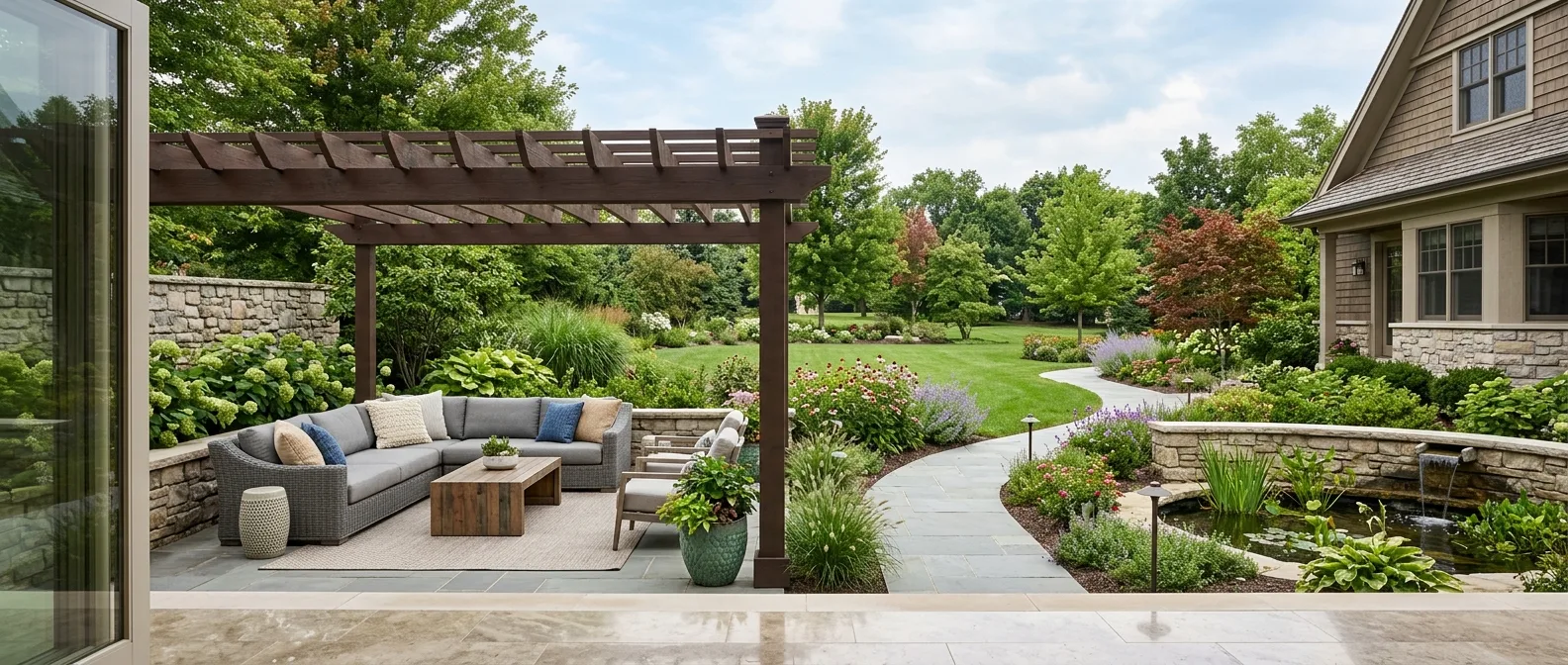
Do concrete patios crack in cold climates?
Yes, and in northern Illinois it's less a question of if than when. A poured slab cracks here for two reasons that have nothing to do with the quality of the concrete itself: frost heave and shrinkage. Our winters drive frost down to about 40 inches, and when saturated Fox Valley clay freezes it expands and lifts anything sitting on it unevenly. The slab can't bend, so it fractures. Control joints help steer where the crack lands, but they don't stop the movement that causes it.
After two decades pouring and repairing on this clay, our rule is simple: a crack in a Fox Valley slab almost never means bad concrete. It means the ground moved and the slab had no way to move with it.
The second driver is the concrete curing itself. As a slab cures it shrinks slightly, and that shrinkage adds hairline cracks even before the first winter. Add freeze-thaw cycling on top, where the surface swings between deep cold and thawing afternoons over and over each winter, and small cracks widen, edges spall, and salt used near the slab in winter chews at the surface. None of that is a defect. It's just what a rigid surface does on ground that won't hold still.
Which patio lasts longer, pavers or concrete? It comes down to repairability
Both can last a long time when they're built right, but they age in completely different ways, and that's where pavers pull ahead in the Fox Valley. When a paver settles or a section shifts after a rough winter, we lift those pavers, re-level the base underneath, and reset the same pavers. No seam, no color mismatch, no new material. When a concrete slab cracks or heaves, there's no clean fix. You patch it and see the patch, or you jackhammer it out and repour, which is the expensive road.
That repairability is the quiet reason pavers win on lifetime value even though they cost more upfront.
- Paver settling: lift the affected pavers, correct the base, reset the same stones. Often a half-day fix, and it disappears completely.
- A cracked slab: patching shows, and a full repour means demolition, haul-off, and starting over on the base.
- Utility access: pavers pull up and go back down over a line or a root issue. Concrete gets cut and never matches again.
- Freeze-thaw wear: individual pavers can be swapped one at a time. Surface spalling on concrete spreads across the whole slab.

How the upfront and lifetime cost actually compare
Here's the honest cost picture without pretending to quote your yard sight unseen. Pavers cost more to install than a basic poured slab, mostly because the base prep and the labor to set each unit take longer. That upfront gap is real, and it's why concrete still gets picked on tight budgets. But the comparison that matters is over the life of the patio, not the day it's installed. A slab that cracks and needs patching or a repour in a handful of winters can erase its head start fast, while pavers that get an occasional lift-and-reset keep going for decades on the same materials.
The base prep that decides everything (and the part budget crews skip)
Whichever surface you choose, the patio lives or dies on what's under it, and on Fox Valley clay that base work is the whole job. Native clay compacts poorly, holds water, and heaves with frost, so we don't build on it directly. We excavate down, lay and compact a deep aggregate base in lifts, and slope the whole thing to move water away from your foundation instead of trapping it under the patio. For pavers we compact bedding sand and lock the field with edge restraints and joint sand. For concrete we're talking base depth, reinforcement, and control joints. Skip that prep to save money and you've bought the exact patio we get called to tear out.
The patio you can see is the easy part. The base, the drainage, and the grade you can't see are what decide whether it's flat and tight in ten years or cracked and heaved by the third spring.
This is also why we handle both the surface and the ground it sits on as one job. Getting the grade and drainage right is the same discipline whether we're building a patio, a walkway, or holding back a slope, and it's the core of every hardscape and landscape design project we take on. If you want a patio built for northern Illinois clay and 40-inch frost rather than for a photo, that's what our paver patio installation across the Fox Valley is built around. Call (224) 325-7922 and Virgil will read your grade in person before quoting.
When concrete is actually the right call
We're not anti-concrete, and there are yards where it's the smarter pick. If you're on a genuinely well-draining lot without the wet clay problem, or you want a large uninterrupted surface for a specific look and you're willing to invest in a deep reinforced base, concrete can serve you well for a long time. Some homeowners simply prefer the clean monolithic appearance, and that's a valid reason. The point isn't that concrete is bad. It's that on the flat, water-holding clay lots we work across Carpentersville, Elgin, and the Dundee area, concrete needs to be built right or it fails predictably, and most budget slabs aren't built right.
When you don't need to call anyone yet
Straight talk. If you already have a poured patio and it has a single hairline crack that isn't lifting, shifting, or letting water pool against your house, you don't need to rip it out. Watch it through a winter or two before you spend money. And if you're early in planning and just gathering ideas, walk your yard after the next hard rain first. Standing water 24 hours later tells you drainage has to come before any patio, and that changes the whole plan. We'd rather tell you to wait or fix the grade first than sell you a surface that's going to fight water the rest of its life.
Frequently asked questions
Which patio lasts longer, pavers or concrete?
Both can last decades when built on a proper base, but pavers hold up better over time in northern Illinois because they're repairable. When our clay heaves a paver section, we lift the pavers, re-level the base, and reset the same stones with no visible seam. When a concrete slab cracks or heaves, you either live with a patch that shows or pay to jackhammer it out and repour. That repairability is why pavers tend to win on lifetime value even though they cost more to install.
Do concrete patios crack in cold climates like northern Illinois?
Yes, commonly. Fox Valley winters drive frost down to roughly 40 inches, and our heavy clay expands hard when it freezes, lifting a rigid slab unevenly until it fractures. Concrete also shrinks slightly as it cures, adding hairline cracks before the first winter, and repeated freeze-thaw cycling widens them. A crack usually means the ground moved, not that the concrete was bad. A deep compacted base and reinforcement reduce it, but no slab is immune on clay.
Are pavers worth the extra cost over concrete?
On a wet clay lot in the Fox Valley, usually yes. Pavers cost more upfront because of the base prep and the labor to set each unit, but they flex with ground movement instead of cracking, and any settling is fixed by lifting and resetting the same pavers. A cheaper slab that cracks and needs patching or a repour in a few winters can erase its price advantage quickly. We won't quote a number sight unseen, but we'll walk you through the tradeoff honestly at the free estimate.
Why does my concrete patio keep cracking?
Almost always because of what's under it, not the concrete itself. If the slab sits on native Fox Valley clay without a deep, compacted, well-drained base, frost heave lifts it unevenly every winter and it cracks along the weak points. Salt used near the slab in winter and normal curing shrinkage make it worse. Patching treats the symptom. The real fix is a properly built base, which is exactly the prep we do before any patio goes down, whether pavers or poured.
Do you build patios across the Fox Valley?
Yes. V. Cardenas Landscaping, Inc. builds paver patios and coordinates hardscape design across the Fox Valley and northwest Chicago suburbs, including East Dundee, Elgin, Algonquin, Carpentersville, South Elgin, Sleepy Hollow, and Barrington Hills. Virgil Cardenas has built and repaired patios on clay-heavy lots across the corridor for more than 20 years, so the frost-heave and drainage problems specific to this part of northern Illinois are ones we've already solved many times. Call (224) 325-7922 and we'll read your yard in person before quoting.